News
SoCal Theme Park Phone Charging: Kiosks, Prices, Crowds
How phone charging works at seven Southern California theme parks: FuelRod kiosks, Legoland rentals, published prices and kiosks per million visitors.
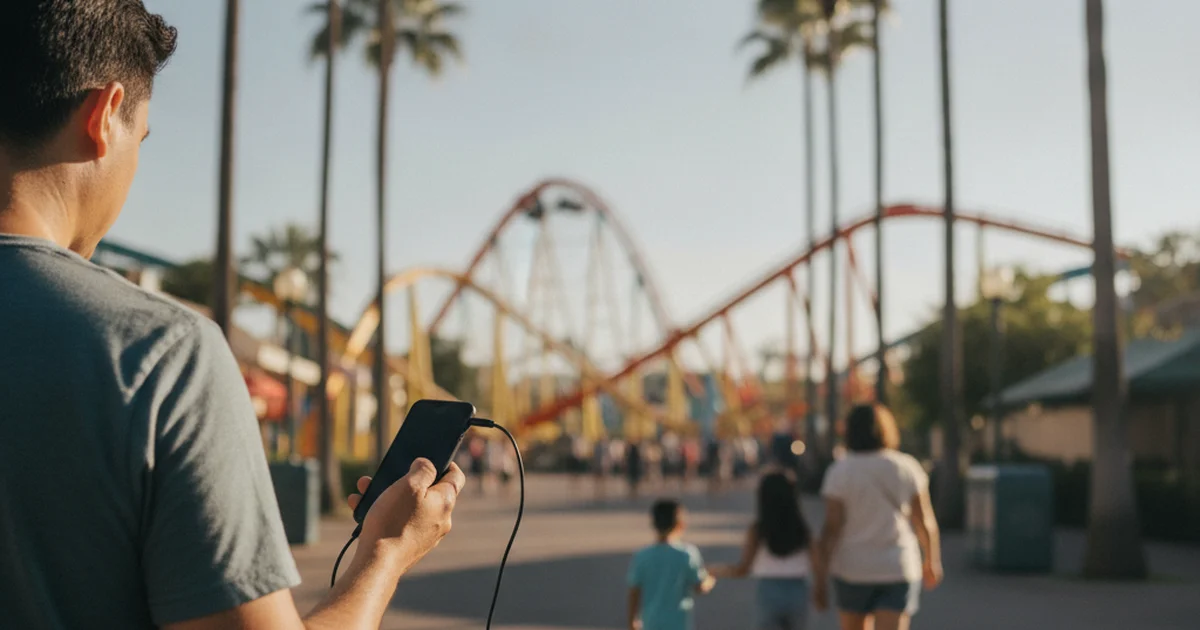
A day at a Southern California theme park now starts and ends on a phone. The ticket is a barcode in an app, the Lightning Lane or the skip-the-line pass is booked in an app, and lunch is often ordered in an app. By late afternoon, after hours of maps, photos, wait-time checks and a weak signal in a crowded queue, a lot of those phones are at 15%.
The parks know it, and most of them have quietly outsourced the problem to a single vendor. Los Angeles Monday checked how phone charging actually works at seven Southern California parks: Disneyland Park, Disney California Adventure, Universal Studios Hollywood, Knott's Berry Farm, Six Flags Magic Mountain, SeaWorld San Diego and Legoland California. We looked at what each park offers, what it costs where a price is published, and how many charging kiosks each park has relative to the crowds it draws.
Why the phone matters more than it used to
At the Disneyland Resort, the phone is close to mandatory. Mickey Visit put it plainly in March 2026: Lightning Lane and mobile ordering "are tethered to guests' ability to use the Disneyland app." A dead battery at 2 p.m. can mean a missed return window, not just a missed photo.
The other parks have moved the same way. Six Flags describes its app as the place to access tickets and passes, order food, load a credit card for purchases and check ride wait times, which covers Six Flags Magic Mountain. SeaWorld San Diego's app turns the phone into the ticket and sells Quick Queue and reserved show seating. At Legoland California, the paid skip-the-line product changed this year: the park says its Reserve 'n' Ride system ended on January 31, 2026, and the replacement, Fastrack, is bought on the day of the visit in the Legoland California app, with the barcode best shown directly from the app because screenshots may not be accepted. Universal Studios Hollywood's own theme park services page points visitors to its app "for exclusive deals and easy ordering."
Knott's Berry Farm adds a twist. In September 2025 the park moved three of its coasters, GhostRider, HangTime and Silver Bullet, to paid ride lockers for loose items, at $3 for up to two hours, according to Theme Park Insider. Phones that fit in a pocket can still ride. That keeps the phone on the guest all day, which is exactly when it drains.
One vendor, six parks
The common answer across most of these parks is FuelRod, a swappable battery sold from self-service kiosks. The guest buys a kit (a small battery plus cables), uses it, and when it runs down, swaps it at any kiosk for a charged one.
FuelRod's own kiosk locator, which we checked on November 20, 2026, lists kiosks inside six of the seven parks we looked at. The only exception is Legoland California, which has no FuelRod listing at all.
The newest addition is Knott's. FuelRod announced the Knott's partnership in August 2026, bringing its second-generation kiosks with a USB-C FuelRod (which the company says has 20% more power than the original) and the MAX10, a 10,000 mAh battery with wireless charging and two USB-C ports. Vending Times reported on August 11, 2026 that batteries bought at Knott's can be exchanged at participating kiosks across FuelRod's network. The release frames the reason the same way Disney fans do: guests rely on phones for "digital tickets and park maps to mobile ordering, ride photos, mobile payments."
What it costs, where the price is published
Here is where a visitor runs into a gap. Disneyland's prices are well documented. Most of the others are only shown on the kiosk screen.
Disneyland Park and Disney California Adventure. A FuelRod starter kit costs $40, and swaps are free for owners, according to Mickey Visit's March 2026 report. The larger MAX10 kit costs $80, also with free swaps. At the time, the MAX10 was sold at one resort kiosk, Gone Hollywood in Disney California Adventure; FuelRod's locator now tags every in-park Disneyland Resort kiosk as selling and swapping the MAX10. Disney's regular lockers cost $7 or $10 a day inside the parks, but they are storage, not charging.
Universal Studios Hollywood. Universal does not publish its Hollywood kiosk prices. The nearest published reference is its Florida resort, where Orlando Informer, in a guide updated February 24, 2026, lists $40 for a FuelRod kit, $3 per swap, $80 for a MAX10 and $4 per MAX10 swap. FuelRod itself, in a January 2026 post, says swap fees "range between $1 and $3 depending on the location/venue." Two of the seven Hollywood listings sit at the Jurassic Park valet and the rideshare area, so not every kiosk is inside the gates.
Knott's Berry Farm, Six Flags Magic Mountain and SeaWorld San Diego. Neither the parks nor FuelRod publish an online price for these kiosks. Visitors see it at the machine. We left these cells blank rather than guess.
Legoland California. Legoland runs its own rental instead. Its services page lists portable chargers at $5 an hour, capped at $25 for five hours, with pickup at Minifigure Market, Technic Coaster, Pirate Shores, Rebuild the World and both hotels. A charger that is not returned costs $20 and the guest keeps the battery.
So the cheapest published full day of phone charging in the region depends on who you are. A first-time Disneyland visitor pays $40 once and swaps free. A returning Disneyland visitor who kept last year's FuelRod pays nothing. A Legoland family that rents for the whole afternoon pays at most $25.
Kiosks against crowds
Price is only half of it. The other half is whether there is a kiosk near you when the phone dies. To measure that, we compared each park's FuelRod listings with its 2025 attendance from the TEA Global Experience Index (formerly the TEA/AECOM Theme Index), as reported by Attractions Magazine.
| Park | 2025 attendance (TEA) | FuelRod kiosk listings | Annual visits per listing | Published one-day charging price | App used for |
|---|---|---|---|---|---|
| Six Flags Magic Mountain | 3,184,000 | 8 | 398,000 | Not published | Tickets, food orders, wait times |
| SeaWorld San Diego | 4,015,000 | 8 | 502,000 | Not published | Ticket, Quick Queue, show seats |
| Knott's Berry Farm | 4,315,000 | 7 | 616,000 | Not published | Tickets, maps, mobile ordering |
| Universal Studios Hollywood | 8,000,000 | 7 | 1,143,000 | Not published (Orlando: $40 kit, $3 swap) | Ordering, deals |
| Disneyland Park | 17,406,000 | 8 | 2,176,000 | $40 kit, free swaps | Lightning Lane, mobile order |
| Disney California Adventure | 10,090,000 | 4 | 2,522,000 | $40 kit, free swaps | Lightning Lane, mobile order |
| Legoland California | Not in TEA top 20 | 0 (own rental stations) | n/a | $5 an hour, $25 cap | Fastrack passes |
Source: FuelRod kiosk locator, checked November 20, 2026 (listings named for each park, excluding two Disneyland listings labelled as employee locations); 2025 TEA Global Experience Index via Attractions Magazine; park and FuelRod pages linked in this article. Visits are TEA estimates, rounded to the nearest thousand per listing.

Chart: Los Angeles Monday analysis of FuelRod kiosk locator listings (checked November 20, 2026) and 2025 TEA Global Experience Index attendance. Visits per listing = 2025 attendance divided by the number of FuelRod listings named for the park.
The spread is wider than the parks' reputations would suggest. A FuelRod kiosk at Disney California Adventure serves about 2.5 million annual visits, more than six times the roughly 398,000 per kiosk at Six Flags Magic Mountain, which has the most kiosks per visitor of any park we checked. Disneyland Park, the second most visited theme park in the world in 2025 at 17.4 million visits, has eight listed kiosks, the same number as Magic Mountain with about a fifth of the crowd.
Some caution on the method. A locator listing is a location, not a count of machines, and one listing may hold more than one kiosk. Attendance counts visits, not people. Disney's free swaps also change the math: many Disneyland guests arrive with a FuelRod they already own and only need a swap, which is quicker than a purchase. The Disneyland Resort also has kiosks outside the two parks, at Downtown Disney and in the three Disney hotels, which we did not count. Even so, the direction is clear. At the busiest parks in Southern California, each kiosk has to cover far more people.
How operators beyond the kiosk incumbent pitch parks
FuelRod's model asks the guest to buy hardware. That suits Disney, where many visitors return and their kits keep working. It suits a one-time visitor less well, which is part of why Legoland chose an hourly rental it runs itself.
There is a third model aimed at venues: the rental station, where a guest borrows a power bank from one station and drops it at another, and the venue does not buy any equipment. ChargerGoGo, a power bank rental operator, took that pitch to IAAPA 2024, the attractions industry's trade show, presenting phone charging stations for theme parks and entertainment centers as a way to improve guest satisfaction while "driving additional revenue." Its venue operators page describes the stations as free to the venue, with warranty, tech support and revenue sharing, and says users can pick up and drop off the battery at any of its stations.
For a park, the trade off is simple to state. A kiosk-and-kit model generates hardware sales and loyalty from repeat visitors. A rental model has no upfront cost for the guest, which lowers the barrier for the family that only comes once. Legoland's $25 cap and Disney's $40 kit are two answers to the same question, and the kiosk counts above suggest that the parks with the biggest crowds have the most room to add capacity of either kind.
What to do on your next visit
- Disneyland or California Adventure: if you already own a FuelRod, bring it. Swaps are free, and the kit you bought last year still works. If you do not, $40 buys one that will keep working on later trips.
- Universal Studios Hollywood: expect to pay per swap, as at Universal's Florida parks, and check the price on the kiosk screen before you buy.
- Knott's, Magic Mountain and SeaWorld San Diego: kiosks are listed in FuelRod's app and locator. Download the app before the visit to find the nearest one; FuelRod says new accounts get a $5 credit.
- Legoland California: rent at Minifigure Market on arrival if you expect to need it. The $25 cap covers five hours.
- Anywhere: a power bank from home is still the cheapest option, and pocket-sized batteries can ride with you at Knott's, where only loose items must go in the paid lockers.
The phone has become the park's ticket, wallet and line pass. Southern California's parks have put a price on keeping it alive, from $0 for a returning Disney guest to $25 at Legoland, and the number of places to do it varies more than sixfold depending on which gate you walk through.
Sources
- FuelRod kiosk locator, listings checked November 20, 2026
- Attractions Magazine: 2025 theme park attendance, TEA Global Experience Index
- Mickey Visit: Disneyland FuelRod options change (March 2026)
- PR Newswire: Knott's Berry Farm and FuelRod partnership
- Vending Times: Knott's Berry Farm installs FuelRod charging kiosks
- FuelRod: How swapping with FuelRod saves you money all year
- Orlando Informer: Phone charging at Universal Orlando
- Legoland California: Theme park services
- Legoland California: Fastrack
- Disneyland Resort: Locker rentals
- Theme Park Insider: Knott's paid ride lockers
- Six Flags: Mobile app
- SeaWorld San Diego: Mobile app
- Universal Studios Hollywood: Theme park services
- ChargerGoGo venue operators page, read November 20, 2026
About the author
Priya Raghunathan
Priya Raghunathan writes about culture and sport for Los Angeles Monday: film and music, the restaurants feeding the city, and the teams and venues carrying it through the week.